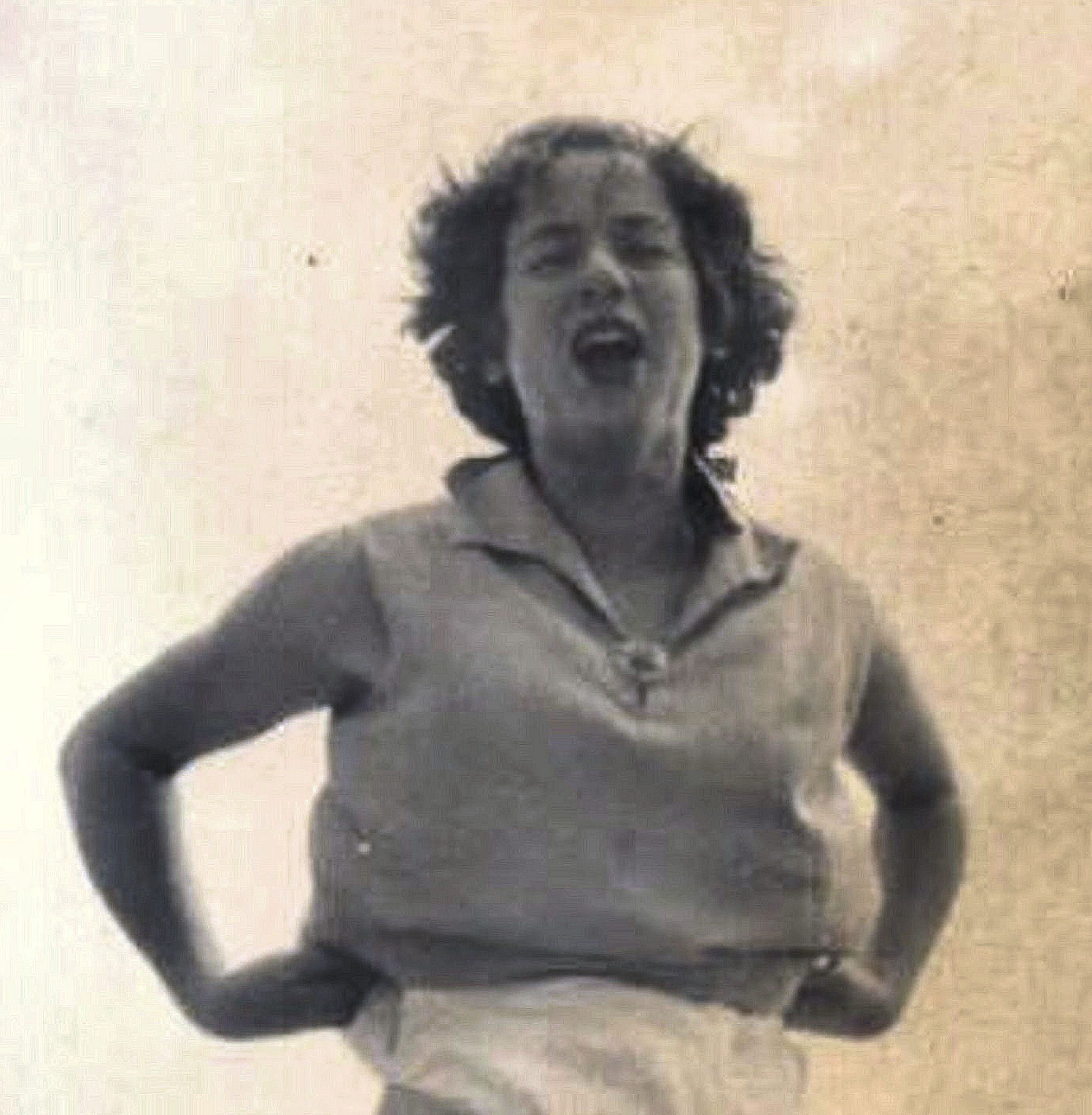
My early childhood was lived in the war years which meant that I was well aware of the world around me, but for me Melbourne was the centre of the universe. Until I was 17, when I went to Sydney with friends by steam train, the furthest I had travelled was to Healesville, the Dandenongs, and Rosebud where we went caravanning for Christmas holidays. In 1951 my cousin had married the most handsome man I had ever encountered and went to live on his cattle station in the Kimberlies. As a 13 year old, I day-dreamed of wearing a little felt hat and gloves as I boarded a plane to visit them. People dressed up for the privilege of enjoying very expensive plane travel in those days, but unfortunately for me the trip remained a dream.

Flower girl at my cousin’s wedding, 1951
Despite living in suburban East Malvern, I knew many areas of the city like the back of my hand. My grandparents lived in North Fitzroy which was still shadowed by the spectre of crime boss Squizzy Taylor, and was yet to become gentrified. As later generations were to discover, the crime bosses never really left the area. Our family car, which graduated from a Crossley to a Vanguard in 1952, made regular trips from East Malvern to North Fitzroy. The highlight of the trip was the Skipping Girl sign in Victoria Parade, Richmond, set on the vinegar factory opposite Ruwolts where my father worked as a mechanical draftsman, and a few doors along from the building where my uncle worked as a watchmaker. On the return trip at night we would eagerly wait to catch the first sight of her lit up against the skyline. She later disappeared to the horror of most of my generation, but fortunately re-appeared even after her surroundings had changed dramatically.
School holidays were well occupied in the area around North Fitzroy or jaunting around the city on a shoe string budget with two maiden aunts, so I acquired the knack of crossing a busy city street with dexterity and fearlessness. Despite the fact that we all had a bike, it was only delivery and newspaper boys who would bicycle around the city in those days. Cars and trams had the wide, straight roads to themselves. The highlight for a twelve year old in the shopping hub of Melbourne was riding Myer’s escalators. The exhilaration of visiting the city became a daily pleasure when the four years at Melbourne University required daily attendance, and afforded the luxury of studying in the Victorian State Library as well as snooping around the city shops.
Our mothers did not drive us around in the fifties so we walked, rode bikes or took public transport. Things changed later in the decade when cars became cheaper and more available. I spent most of my school life at MLC, travelling from East Malvern to Hawthorn by train and tram. There were few high schools available in the 50s and my options would have been Camberwell High School, requiring a train and two tram trips, or McRobertson Girls High School in the city. MLC was highly regarded for encouraging girls to further their education, while instilling sound home-making values at the same time. Our grey serge tunics had three large pleats held in with a waist band, very similar to those worn by British private school students of that period. We were always expected to wear hats and gloves in public and woe betide any undisciplined student who was reported for unseemly behaviour on public transport. In the afternoon the tram stops buzzed with girls whose uniforms had been checked by the prefects on gate duty. There were no mothers in SUVs lined up to drive us home.
Schools at the time did not provide the camps and excursions which children have enjoyed in later decades, however MLC offered a range of clubs which met at lunchtime. There was also a hiking club which took us out to country destinations such as Hurstbridge for a day’s walk at weekends. I did not belong to the choir or the dramatic club, so spent a lot of time with my head in books. I did belong to the Student Christian Movement at school and university and enjoyed many camps and social activities with people I still meet from time to time.
After completing year 11 in 1953 many girls left school with their leaving certificate which entitled them to do nursing, physiotherapy or occupational therapy. Some had opted to devote year 11 to secretarial studies, becoming eligible to go straight into the workforce at the end of the year. Others of us continued on to complete year 12, travelling in to the Exhibition Building to join all the other city students sitting the external exams in December. We had considered our options of university studies accessible through Commonwealth scholarships awarded to any students with creditable matriculation (year 12) results. If we wanted an income while studying, the easy option was teaching which allowed us to do a full degree and Bachelor of Education in return for serving with the Victorian Education Department for three years. As a result many of us went off to country towns. We accepted the lower salaries earned by women and the fact that when we married we resigned in order to receive our superannuation, or continued without it.
With a long Methodist pedigree, much of my social life centred around the church. From an early age I went to Sunday School on a Sunday afternoon. I joined Rays, a group for young girls which met weekly, and later graduated to the senior group, Comrades. Children were allowed an escape from the morning church service by attending Christian Endeavour which provided lighter religious activities in the hall out the back. All these groups had regular ‘socials’ which involved games and food. The highlight of the Sunday School year was the picnic held at Ferntree Gully on Melbourne Cup Day. This involved us squeezing into a hired furniture van singing songs about the hip bone connecting to the leg bone and such like to occupy the long slow trip. As we grew older we became eligible to attend weekend youth camps held on a regular basis at guest houses in the Dandenongs. I formed a close circle of friends which extended to other social events such as Saturday night dances at church halls or local town halls. Saturday afternoon would be devoted to washing my hair and getting prepared for the big night out. Our dresses had very full skirts which required heavily starched petticoats, preferably with hoops. These were very expensive, so I improvised and made mine with wire I scrounged in dad’s garage. Unfortunately the stitching gave way in the middle of a dance and I was totally mortified when a friend drew attention to the length of wire trailing around behind me.
Square dancing was extremely popular in the early fifties. Community groups such as scouts raised money by playing recorded dance calls for the enthusiastic square dancers. Women wore their full skirts and peasant blouses to do-se-do to the chicken in the bread pan, sacheying around their partners to the lively beat of music.
Melbourne people had close networks, and when making a new acquaintance you could usually find common links within minutes. The city was changing with the influx of Greek and Italian migrants who chose to settle together particularly in suburbs along Sydney Road, Brunswick, but unless you lived in these areas your daily life was unchanged by their arrival. The big impact which did register on our radar was the coffee. Because of the interruption of the war years it is hard to judge just what café culture Melbourne traditionally enjoyed, particularly in comparison with Sydney. When I went to Sydney by steam train for a Methodist youth conference in 1955 I was horrified that at 10.00 pm.at night we had to walk a long distance past closed cafes before finding a greasy milk bar which offered nothing of interest. This would not have been the case in Melbourne where there was a strong tradition of going out for supper after an evening at the theatre.
After the deprivations of the war years, families in the fifties embraced newly available home appliances. My parents bought a refrigerator before many other families in the street who continued to depend on ice chests and the regular deliveries by the ice man. They installed a gas fire in the fireplace so eliminating the work of an open fire and allowing instant ignition. The flame heated the ceramic ‘candles’, fragile panels which fitted into the front of the unit and radiated the heat. Eventually the candles would break and require the expense of replacement. Unfortunately for me as an asthmatic, they also invested in a smelly kerosene heater which could be moved from room to room. My mother used a gas fired copper and grey concrete trough to do the washing and hung the clothes on a line strung between one side of the back yard and the other. It was well into the fifties before she invested in a little spin dryer. Other more progressive neighbours were investing in twin tub washing machines.
My father brought home a record player much to our delight. He invested heavily in Readers Digest sets of classical records which he played at early hours of the morning as we tried to sleep in. My younger brother had his own record, Davy Crockett, which was played repeatedly. The only record I can remember which might have been mine was the musical ‘Salad Days’. The wireless was our main source of entertainment in the evenings and at weekends. Probably the most popular in our house was Bob Dyer’s ‘Pick a Box’ which was a quiz show offering prizes depending on which box you picked. Dick Fair’s ‘Amateur Hour’ provided an opportunity for aspiring performers to showcase their talents, Jack Davey’s ‘Ampol Show’ provided entertaining quiz questions, and John Dunne on ‘Fifty and Over’ interviewed couples individually to discover the most annoying traits of their partners. Sunday night was not complete without the Caltex Theatre drama show. The Gracie Fields Show was also popular: Gracie was a well-known English singer/entertainer. If we were home unwell we might listen in the afternoon to ‘Courtship and Marriage’, romantic stories of the O’Keefe sisters choosing between marriage and a career. Then there was the long running lunch time saga of Blue Hills, but it did not get much attention in our house. The show which I most remember was ‘Daddy and Paddy’ on 3DB, but this may not have survived long into the fifties. The main children’s program was the ‘Argonauts’ which featured stories and competitions, and most importantly allowed you to join the Argonaut’s club with the name of one of the Argonauts followed by a number. Many children participated enthusiastically in this show, but I was never a fan. Then there were the series ‘Gulliver’s Travels’ and ‘The Amazing Adventures of Biggles’.
The highlight of our year was the six week caravan holiday on the Rosebud foreshore. Claiming a good site was very competitive, and each year my parents roped off a site a couple of weeks in advance. Camps were elaborately equipped for the time, with some families filling their tents with furniture transported in vans. The facilities on the foreshore were quite basic, but as children we never tired of the beach and the tea-treed foreshore. My father had spent nine months in the late 40s building the caravan, tirelessly soaking Masonite sheets until they could be curved to the required shape. He occupied himself in the fifties building a yacht for my young brother to sail at Rosebud.

Ready for Rosebud, photo Joan Beddoe
The Olympic Games is the event which is embedded in the memories of all Melbournians who lived in the 1950s. The city was decorated with lights and bunting and Melbourne took on an international flavour. Like the many people who enthusiastically lined the routes for the marathon and walks, we went up to Dandenong Road to cheer the walkers. I bought tickets for the family to attend the Saturday athletic events at the MCG where there was a carnival atmosphere without the security and formalities of later Olympics. I will never forget the electric atmosphere as Betty Cuthbert ran the last leg of the relay to win for Australia.

In the week prior to the games I was working at ‘Tim the Toyman’ and one day an American came in to choose an array of toys to have sent home. Our eyes boggled at the amount he was spending. It took us quite a while to package his purchases and we were completely dumbfounded when he failed to show up to pay for them the next day as arranged.
At the end of 1958 those of us who had completed our Dip. Ed. with the Education department gathered to hear our teaching appointments read out. My mother was so apprehensive that I would have to cope in a remote country town that she took herself to bed quite ill. Luckily I came home with the news that I was going to Camberwell High and she made an instant recovery. So the 50s ended on a blissful note of a great job and engagement to be married after completing the necessary three years with the Victorian Education Department.
 1950's Melbourne