Brenda
The fifties in Melbourne began on a sad note when I was thirteen years old with the death of my close school friend from poliomyelitis. She had been away from school for only a couple of days when the principal announced her death at assembly. She was a very fit girl with beautiful skin and fair hair and was no mean tennis player. There was no counselling in those days and no staff member spoke to me about her death. The disease had been a scourge in the fourties and was a problem for the Queen when she visited Perth in 1954. There were 200 reported cases there at the time, so she took all her meals, which were flown from Melbourne, on board the Royal yacht. Fortunately the Salk vaccine became available in 1955 and polio became a thing of the past. During the Queen’s visit to Melbourne during that tour, I participated with thousands of other school children in the event at the Melbourne Cricket Ground (MCG), performing gymnastics and maypole dances. We lined up in groups on the ground to wave as she drove among us with Prince Phillip.
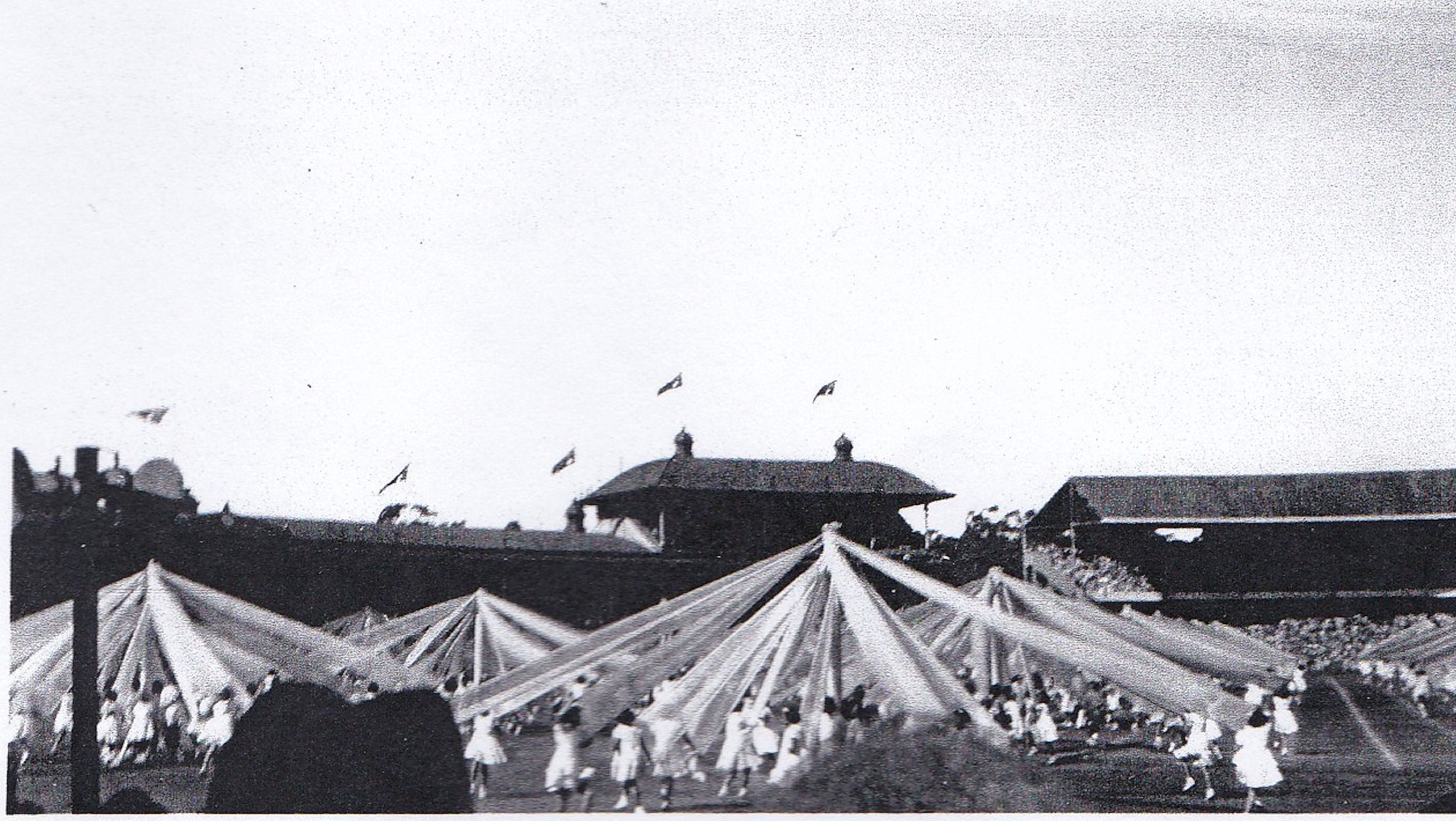
School children’s display, MCG, photo courtesy Brenda
A favourite place for families to go in September was the Royal Melbourne Show. My mother would meet me after school and we took the train into the city to my father’s workplace. He then drove us to the showgrounds near the Flemington racecourse. The experience of farmyard smells and contact with cows, goats and lambs was exciting for city children. Show bags were modest and practical by later standards. They contained small packets of biscuits, tea, cornflakes, a chocolate frog and a twirling windmill on a stick. Women would drool over the scrumptious cakes on show, and gaze with envy at the the artistic knitteds and tapestries displayed. As darkness fell we would watch from the stand as clever cattle dogs herded sheep into their pens.
Throughout the fifties my parents took me to the Anzac Day march. My father had given service in both world wars, so it meant a lot to a child to attend and wave to the returned servicemen and women as they marched along St Kilda Road. In 1954 I was particularly privileged when the MLC school choir was invited to lead the singing of hymns at the Anzac Day service at the Shrine of Remembrance which stands amongst beautiful parklands facing the city of Melbourne. We assembled in Alexandra Avenue alongside the Yarra River and marched up to the Shrine forecourt and eternal flame. Construction of this WWII memorial had been completed in time for the Royal Visit in February 1954. Queen Elizabeth II lit the flame during the dedication service and her signature and that of Prince Phillip are recorded in the sanctuary along with the names of servicemen and women.
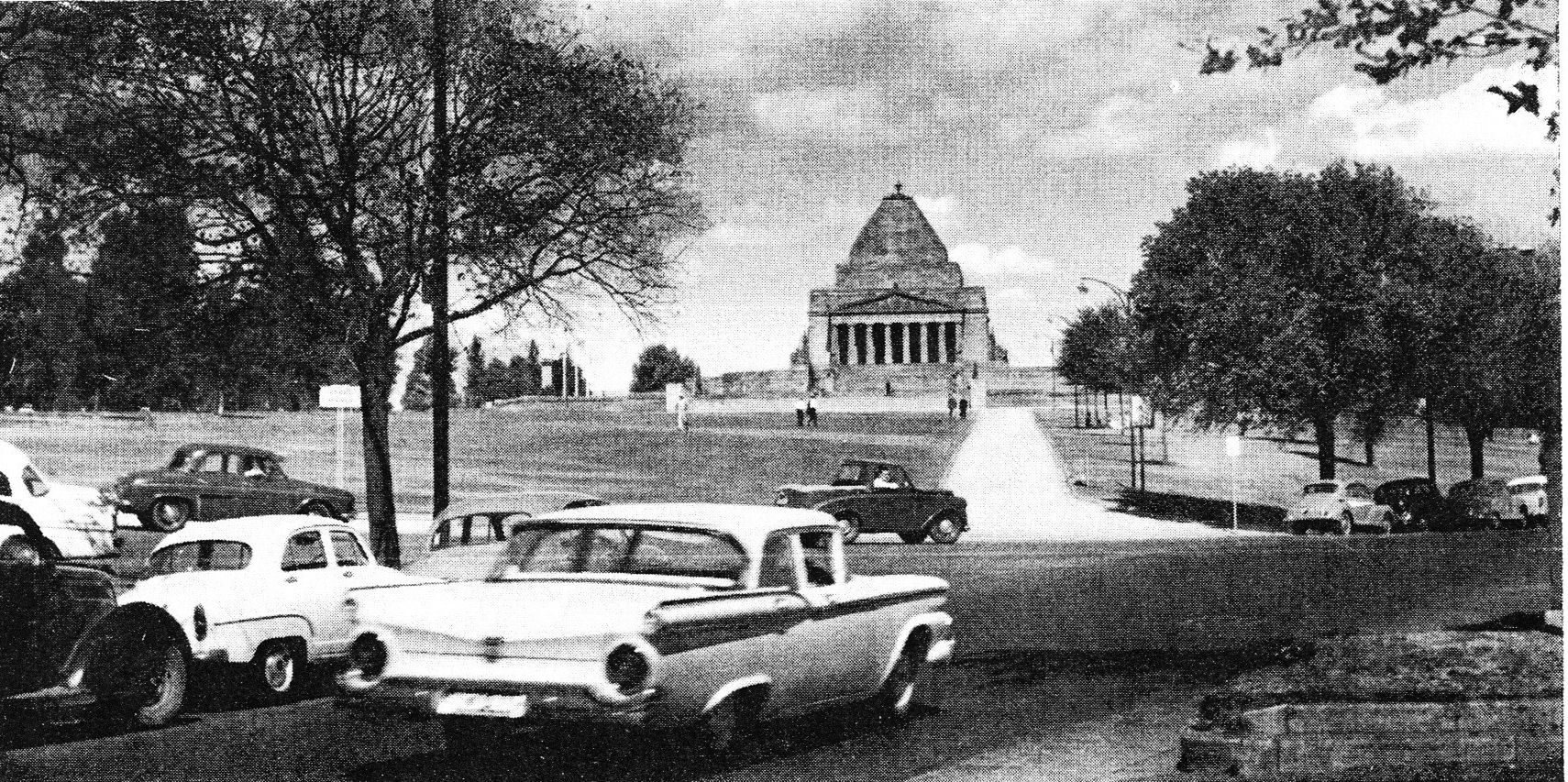
Shrine of Remembrance before the addition of the forecourt
Courtesy Gordon De Lisle photography in ‘Melbourne+Big+Rich+Beautiful
After completing a business diploma I went to work as a stenographer at Snow Elliott, silk importers in Flinders Lane. My job involved dictation in shorthand, and typing letters and invoices. When the secretary to the accountant was required to resign because she was getting married, I was appointed to her position which included the duties of cost clerk. Initially I used the old black manual Royal typewriter, but following the arrival of Olivetti in 1954, it was not long before a green electric one was purchased. It was very streamlined, quieter and quicker, with a lovely soft touch and it could be pre-set for margins and spacing.
The company imported a variety of materials other than silk. Rolls of organza, tulle, lace, cotton and terylene were brought up from the docks in trucks and eventually ended up on long tables to be cut to order for the customers which included the large department stores, Georges, Myers, and Buckley and Nunn. It was my job to keep the records in the large costing book on my desk. The warehouse was one large floor with partitioned areas for the managing director, manager, accountant, and office staff. There was a tiny kitchen area where we could stand for morning tea and lunch. The reception area displayed the materials and in one corner there was a switchboard operated by the receptionist. When calls came through on the three extensions, little shutters would drop underneath the levers.
At lunch time I would go out to meet friends or shop, usually at the Mutual Store in Flinders Street or browse in Allan’s music store in Collins Street for sheet music. Several times we would work back in the evenings if there was a large order or a stocktake, and this necessitated the staff going out for a quick meal. Being a small company there was almost a family atmosphere. Having access to materials at a discounted price, I developed an interest in making my own clothes (using Simplicity patterns) on my grand-mother’s treadle Singer sewing machine.
I made my debut as was the custom in those days. The group rehearsed for the ball with our partners conscripted from the Frogmore Air Cadets Academy in Hawthorne. Wearing my white dress made by the local dressmaker at the East Malvern shopping centre, I curtsied to the Mayor at the St. Kilda town hall. The traditional return ball was held at The Gables.
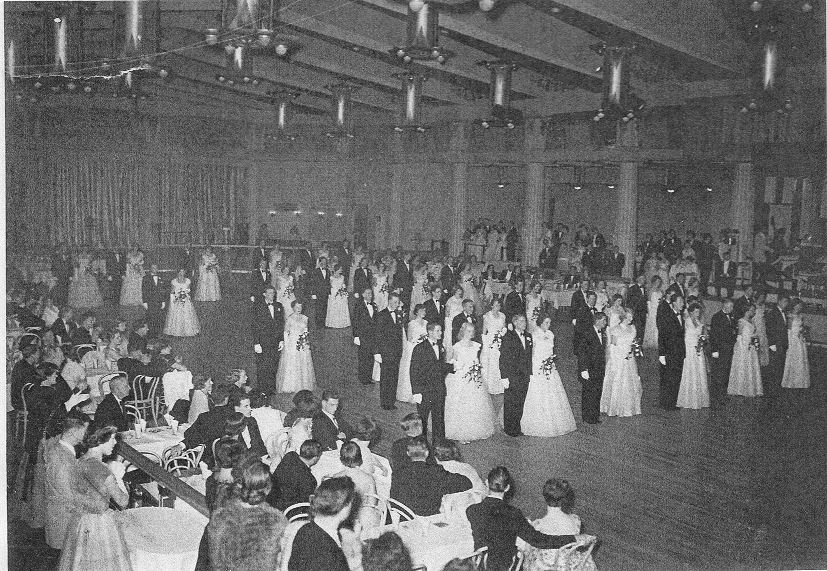
Debut Ball
Courtesy Brenda
We relied on the radio for our news, information, music, recipes and handy hints. The ABC serial ‘Blue Hills’ was loved by many families: some towns even stopped to hear the broadcast. It embraced the lives of people living outside the metropolitan cities and ran for 32 years from 1949 as part of the ‘Country Hour’. I always loved hearing the latest pop songs on the radio. It is interesting to note that the first ‘hit’ songs of the 50s were influenced by romance and love: from 1950 to 1954 Mona Lisa, Because of You, I Saw Mummy Kissing Santa Claus, I Love Paris, and Three Coins in a Fountain made it to the top of the charts. Then there was a change of subject and rhythm with Rock Around the Clock, Sixteen Tons, the Pub with no Beer, and Tom Dooley. I learned piano for a few years, but it was my mother and her neighbours who had the real talent and on occasions we would have sing-songs around the piano with them. This was before the arrival of television in 1956, and when that happened I would loiter in front of shop windows watching the pictures. 1956 was the year of the Olympic Games and I was thrilled to see some of the swimming events at the pool specially built near the Yarra. Ticket prices ranged from eleven shillings to three pounds four shillings.

courtesy of Brenda
I was very interested in ballet, and the highlight of fifties in Melbourne would have to be the Australian debut performance by Margot Fonteyne in 1957 at her Majesty’s theatre where I studied ballet to grade 5. I went around to the stage door after the performance to see her emerge in her fur coat and evening dress: she looked so elegant. Fonteyn performed with the Borovansky Ballet Company and guest members of the Royal Ballet. The Borovansky Australian Ballet had been formed in 1940 by Borovansky and his wife who had decided to reside in Melbourne after a distinguished international ballet career. They formed the Borovansky Jubillee Ballet in 1951 with sponsorship from J.C. Williamson and the Education in Music and Dramatic Arts Society. The company presented ambitious productions in all capital cities of Australia. After Borovansky’s death in 1959, his company provided the nucleus for the Australian Ballet formed in 1962.
The film ‘On the Beach’ (about the end of the world) was released in December 1959. It was set and filmed in Melbourne where people could catch a glimpse of the glamorous Ava Gardner who remarked that ‘Melbourne sure is the right place to film it’. Some scenes were shot under the beautiful trees of St Kilda Road, and others on the Canadian Bay beach on the Mornington Peninsula, where my family occasionally swam.
Another official visitor in 1959 was Princess Alexandra of Kent who represented the Queen at Queensland’s centenary celebrations. She was a graceful young Royal of our generation and I admired her stylish clothes. I went down to see her alight from the royal train when it arrived at Spencer Street station (it became Southern Cross station 50 years later). She attended a children’s display at the MCG and my mother was lucky enough to manage a snapshot which I treasured.
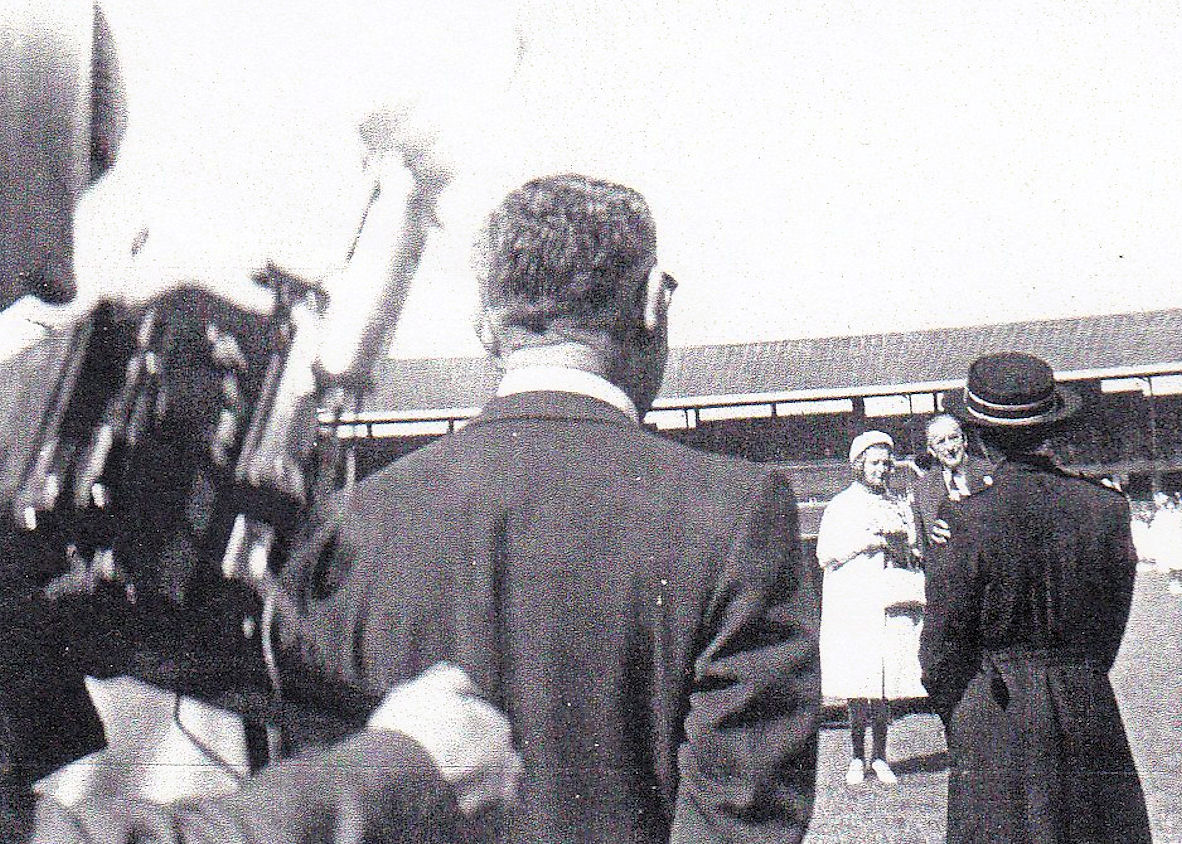
MCG, photo courtesy Brenda
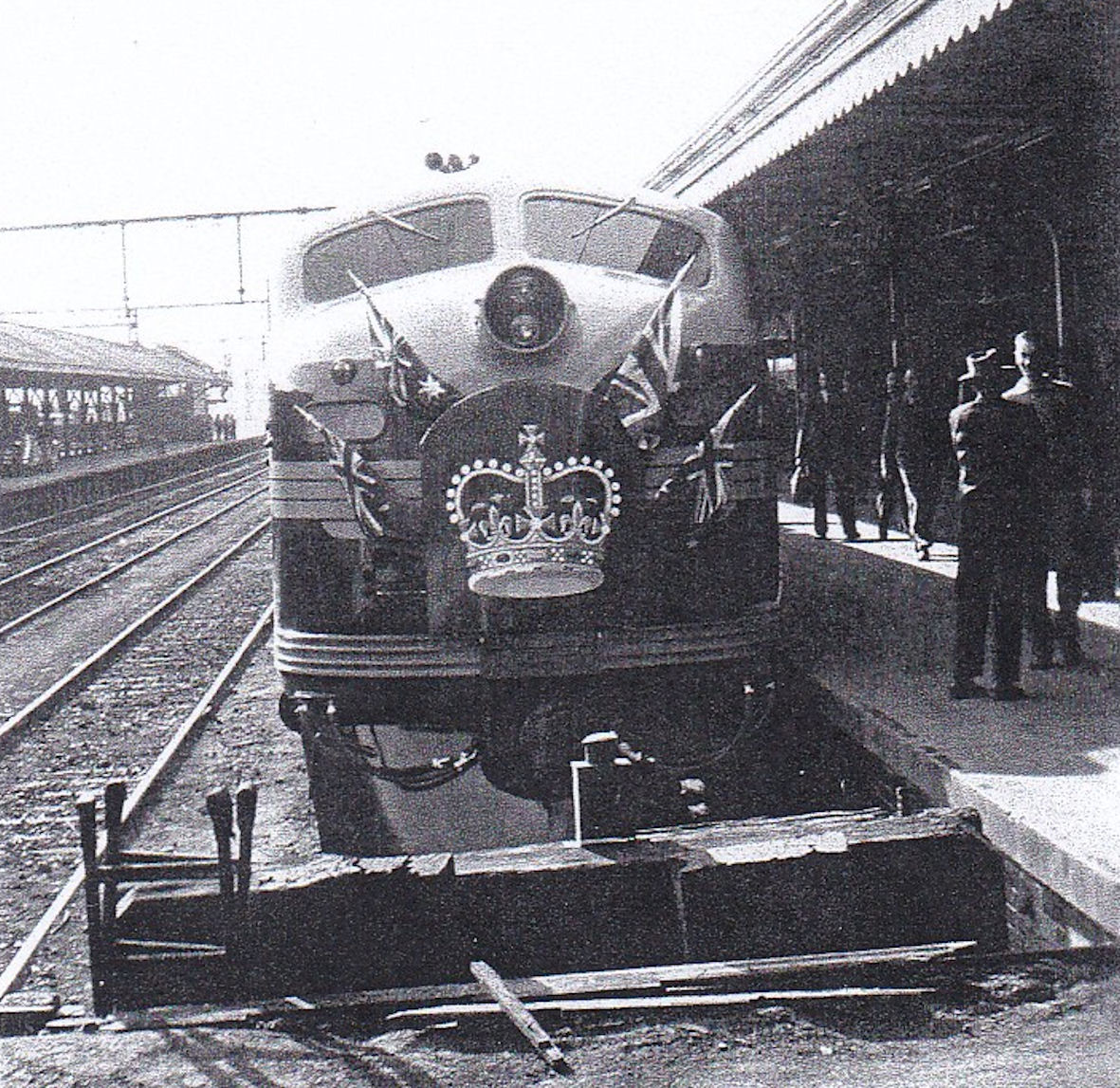
Princess Alexandra’s train, photo courtesy of Brenda.
The Myer music Bowl opened on the Kings Domain near the Botanical Gardens in 1959. It was a bequest to the people of Melbourne from the Sidney Myer estate. My parents and I enjoyed many free Sunday afternoon concerts in the summer, sitting on a rug and listening to opera singers accompanied by orchestras.
Holidays for many Melbournians who did not go to the Mornington Peninsula involved stays at guest houses in Marysville, Warburton and Lorne. These provided social and sporting entertainment while ensuring a home from home sense of safety. A week at Erskine House at Lorne was a rite of passage for many of Melbourne’s young people.

Erskine House post card, 1956, supplied by Brenda
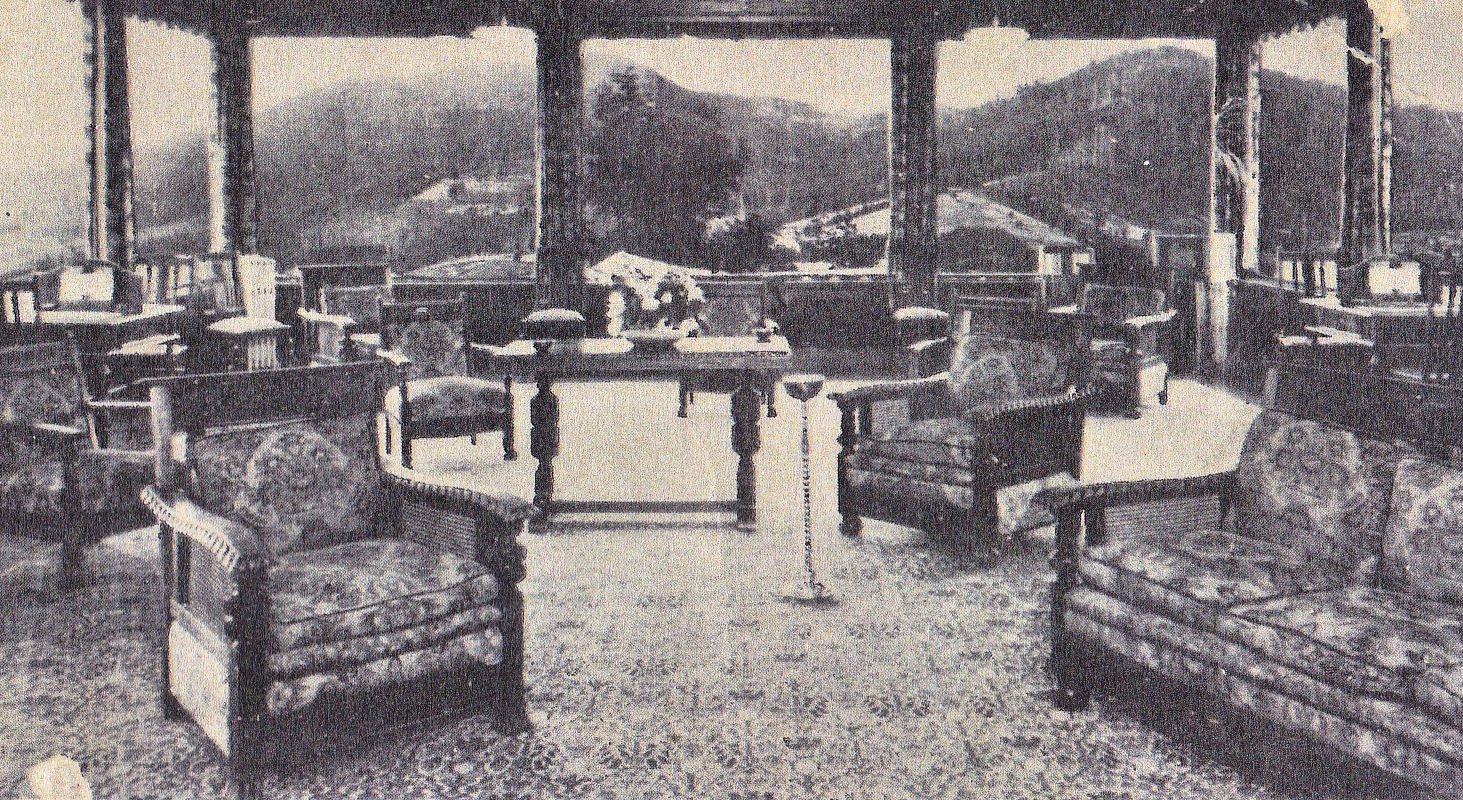
Lounge room of the Warburton Chalet, post card supplied by Brenda
The MCG has many memories for me, in particular the cricket. My grandfather belonged to a cricketing family and his membership of the MCG entitled us to two ladies tickets which were shared around between my grand-mother, my mother and myself. The members’ pavilion was reserved strictly for the men, so my grand-father would sit on one side of the cyclone wire fence and we would wave to him from the other side. We would take sandwiches and a Thermos and often meet friends who shared our enthusiasm for the game and the excitement of getting players’ signatures. Many years later when my father’s name reached the top of the members’ waiting list, only one ladies ticket was issued. It would not be until 1969 that the newsletter announced that ladies would be admitted to some functions.
1959 was a turning point for me as I decided to pursue more fulfilling work and commenced nursing at Prince Henry’s hospital in St Kilda Road. This led to a long and interesting career. The 1950s in Melbourne had been greatly influenced by the after-effects of WWII. When the decade started, petrol rationing had only just been lifted. Most people used public transport and it would be some time before women could think about owning a car. My family had the use of an Oldsmobile belonging to my grand-parents who came to live with us from 1952 to 1955. When the radiator began to have problems, leaving us stranded on one too many occasions, my father bought a Morris Oxford which was much more suitable. Streets in Melbourne in the fifties were quieter, the pace slower, and there was more romance…. nice memories.
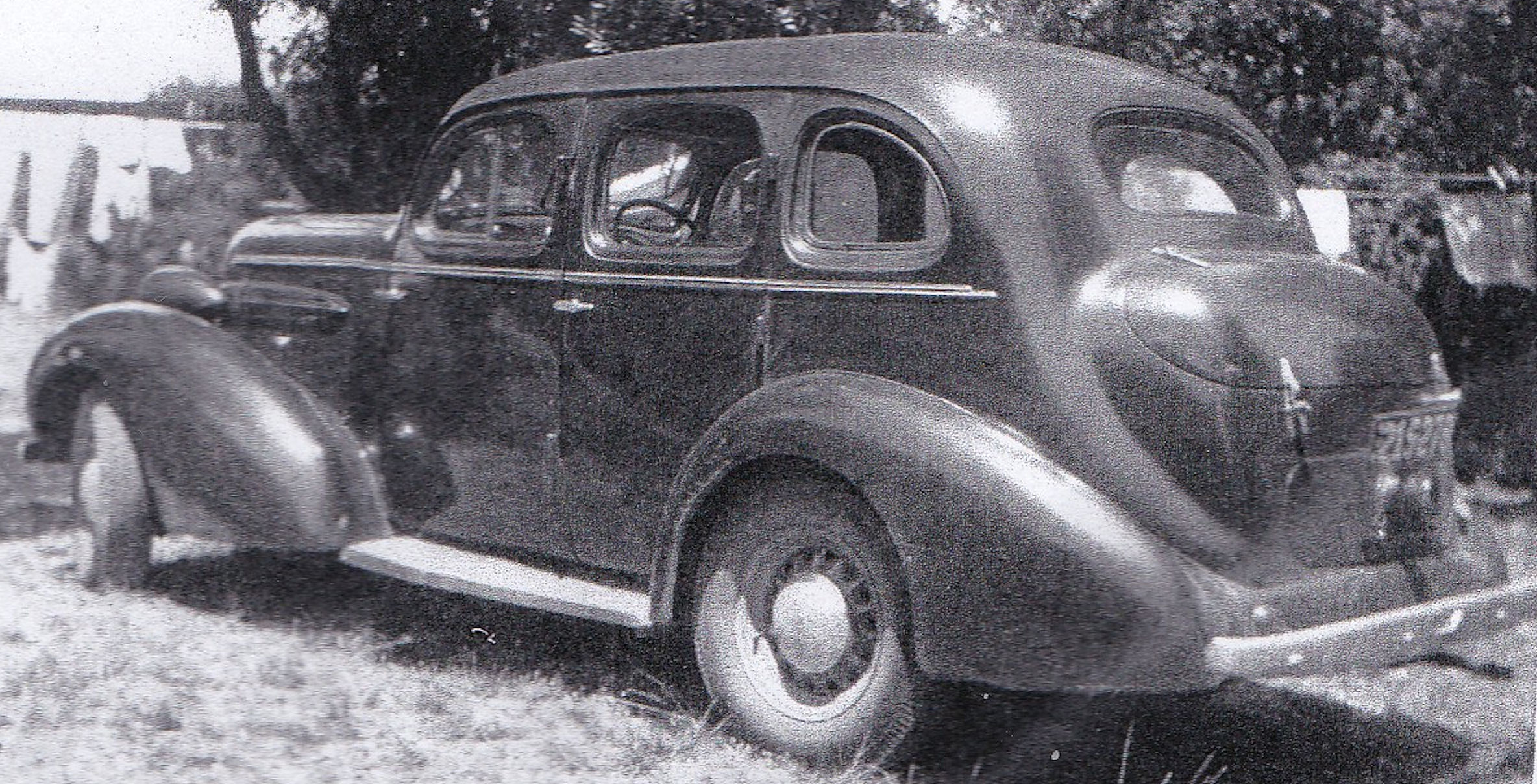
Our Oldsmobile
 1950's Melbourne