International Affairs
Menzies’ Liberal National Party offered stable government throughout the fifties, however international affairs cast a grim shadow over the political arena. The decade was dominated by the cold war between the Soviet Union and the west. It had gathered strength following the division of Germany after the war: eastern Germany became part of the Soviet Union while the west enjoyed massive reconstruction funded by the United States
The fear of communism was rampant in Australia during the early 50s. Menzies’ government successfully pushed through legislation banning the Communist Party in 1950 but it was immediately declared unconstitutional by the High Court. Fears of communism were fuelled when communist led North Korea invaded South Korea in June 1950 and as a result Australian soldiers were called on to support the United States. There was widespread fear of escalation but the conflict was contained with an armistice in 1953 which left Korea permanently divided. Of the 17,000 Australians who served, there were more than 1,500 casualties including 339 deaths. The drama of the cold war came into every household with news reports of the defection of the Russian diplomat, Vladamir Petrov in 1954. When he sought asylum in Canberra, Russian authorities put his wife on a plane for Moscow, however she was rescued at Darwin airport when transferring flights.
Conflict over the Suez Canal was another source of anxiety which created an atmosphere of uncertainty for Australians desperately trying to put international conflict behind them. Nasser became President of Egypt in 1954, two years after the king had been forced to abdicate. In 1956 he nationalised the canal which had been under French and British control. This posed a serious threat to British and French shipping, and they replied by bombing Cairo. The dispute was forced to a resolution by intervention from Russia, the USA and United Nations and the canal was re-opened in 1957.
Australians were reminded of the spectre of warfare by the reports of British atomic tests at Maralinga in South Australia: there were seven nuclear weapons tests between 1956 and 1957. In addition the major powers were ramping up their nuclear programs: in March 1954 the US exploded a hydrogen bomb on Bikini Atoll in the Pacific, followed in November 1955 by a successful test by the USSR, and in May 1957 Britain exploded its first hydrogen bomb on Christmas Island. Intercontinental missiles were also being developed.
In response to these uncertainties Australia developed close ties with the United States throughout the 1950s beginning with the ANZUS treaty in 1951. Australia’s defence was strengthened when the South East Asia Treaty Organisation was signed off in Manilla in 1954 by Australia, Great Britain, France, New Zealand, Pakistan, the Philippines, Thailand, and the United States. Despite initial fears of Japan’s rearmament Menzies’ government gradually built up a strong trade relationship with that country over the next decade. At a local level young men felt the effects of cold war tensions: the National Service Act 1951 required men over the age of 18 to engage in training for 176 days and remain in the reserves of the Commonwealth Military Forces for five years after their initial enrolment. Of the 500,000 men who registered 227,000 were trained between 1951 and 1959 before the scheme ended in 1960.
Immigration
From 1947 the government organised the immigration of displaced persons from Europe. A total of 170,000 such migrants had arrived by 1953. Many lived in hostels until they were sent to regional areas where they were required to work for two years. By 1953 there was less interest, so assisted immigration was offered to Europeans willing to work, particularly those with family contacts in Australia. The ‘populate or perish’ policy enabled large numbers of Greeks and Italians to immigrate. The Greek born population in Australia doubled between 1952 and 1954, and by 1961 it reached 77,333. The 201,428 Italians who arrived between June 1949 and July 1959, made up 16% of all immigrants. In 1947 there were 33,600 Italian born residents in Australia and by 1961 there were 228,300.
The ‘Bring out a Britain Campaign’ was launched in 1957. In the same year Australia volunteered to accept 14,000 Hungarians affected by the invasion of their country by the USSR. Also that year non-European migrants with 15 years residence in Australia were declared eligible to become Australian citizens. The following year the Immigration Act was revised with no reference to race or the long-standing dictation test. The test had been used to discriminate against certain nationalities, and its removal marked the beginning of the end of the White Australian Policy. Further changes were introduced in 1959 allowing resident Australian citizens to sponsor their non-European spouses and any non-married children, who could then apply for citizenship.
This prolific immigration placed pressure on housing so migrant hostels became a common feature in both the city and country areas. At the end of the fifties 26,225 people were housed in 30 facilities.
Indigenous Affairs
For most Australians living in major cities in the 50s, Aboriginal people were a shadow which barely crossed the threshold. The painter Albert Namatjira was well known and there was a general awareness of the skills of Aboriginal stockmen and trackers in outback Australia, but otherwise very little was known about the lives of Aboriginal people. While most lived on cattle stations or reserves run by the government or church organisations, a few still lived traditional lives in very remote areas. None of them enjoyed the rights or benefits afforded to Australian citizens.
There were several distinguished Aboriginal figures who came to public attention in the 50s. Doug Nicholls first became well known as a talented footballer. He was then ordained as a pastor of the Church of Christ and worked as an advocate for his Aboriginal people, becoming a field officer for the Victorian Aboriginal Advancement League formed in 1957. The following year this organisation joined with similar bodies to form the Federal Council for Aboriginal Advancement. The group campaigned for changes in the constitution to allow the Commonwealth government to legislate on Aboriginal affairs. Doug Nicholls was made a member of the Order of the British Empire in 1957 and later became Governor of South Australia. Two well-known entertainers were singer and song writer Jimmy Little who was beginning his long career in 1951 and Harold Blair who established his career as a tenor.
Snowy Mountains Scheme
The Commonwealth government began this ambitious project in 1949. It was designed to divert the water of the Snowy River through a series of hydro-electric stations built in the Snowy Mountains of New South Wales. It required specialised engineering skills and many Europeans were attracted because of lack of work in post-war Europe. Each year around 7,300 workers were employed and by completion in 1974, a total of 100,000 people from 30 countries had been employed. Seventy percent of these were migrants.
Medical and scientific Developments
One of the major threats to health in the 1950s was polio. There had been two previous outbreaks in the thirties and forties. The Salk vaccine was introduced in Australia in 1956 and this proved a turning point in treatment. Only 1% of people who contracted the disease showed severe symptoms, known as paralytic polio, but this represented 40,000 Australians in the years between 1930 and mid-1960.
Antibiotics, cortisone, antihistamines and drugs to treat mental illness appeared during the 50s. Doctors in the US were exploring heart surgery, pacemakers, organ transplants and the science of DNA. Although the contraceptive pill was being developed in the US, it was not used widely in Australia until the 1960s.
The Commonwealth Scientific and Industrial Research Organisation (CSIRO) developed significant products during the 1950s. These included the solar hot water system and permanent creasing in woollen garments. Their flame ionisation detector was applied in environmental monitoring, medical and biochemical research, and chemical analysis in the petrochemical industry. One of the major achievements of the decade was David Warren’s invention of the ‘black box’ voice and instrument recorder in 1958.
Social and work Issues
In the 1950s assistance was extended to families and pensioners. Child endowment had been introduced in 1941, and in 1950 it was extended to cover the first child. The Pensioner Medical Service was established in 1951 to provide free medical treatment to pensioners with payment made directly to doctors and hospitals. Pensioners became eligible for rent assistance in 1958.
It was not until the introduction of the single mother’s pension in the 1970s that women could more easily consider rearing their children without family support. Accordingly institutions run by churches and charitable societies cared for women giving birth to illegitimate children who were then routinely offered for adoption.
Australians continued to work a 40 hour week during the fifties, the female wage rate increased from 54% to 75% of the male wage in 1950, and New South Wales led the other states in the introduction of long service leave in 1952.
Communications
The Commonwealth Post Master Generals department was responsible for postal facilities, telephone and telegraph services in the 50s. Phone numbers were preceded by letters e.g. UL5011. Subscriber trunk dialling (STD) required a call to an operator who placed the call. Telegrams were sent if normal mail delivery was too slow for the task: they were an integral part of weddings and celebratory events, and everyone enjoyed the ritual of telegrams being read out to guests. The telex became available in 1954 allowing messages typed on the electric typewriter to be relayed along telegraph lines.
There were no photo copiers, scanners or fax machines in the 50s. If you needed to reproduce a document the best method was the Gestetna or Roneo duplicating machines which used a master wax coated stencil. Information was typed, written or drawn on this sheet which was placed around an ink infused roller. The ink was then forced through the stencil on to the plain paper to reproduce a limited number of copies as the roller was turned by hand.
Radios changed dramatically in the 50s with the advent of the transistor radio which allowed them to be fitted into cars or carried easily.
Musical recordings
The fifties saw the emergence of the long playing stereophonic vinyl record. Long gone were the 78 rpm records played on a wind-up gramophone. Because of the war, luxuries such as record players had been in short supply and not high on a family’s priorities while the wireless met so many needs. However things changed with the availability of long play 12 inch, 33 and one third rpm vinyl records after 1948. Record players became radiograms and then stereograms designed as stylish pieces of furniture still popular in the 1960s.
Royal Visit
The two month visit of Queen Elizabeth commencing on 3rd February 1954 was a major highlight of the 50s. It was the largest public event ever organised and more than 70% of the Australian population turned out to see her. She opened the third session of the twentieth Parliament in Canberra as well as meeting ordinary citizens.
‘The Queen in Australia’, the official film of the visit, was the first colour feature film to be made in Australia. The musical accompaniment composed by three Australian musicians was recorded by the Sydney Symphony Orchestra. The script was written by George Johnston and TAG Hungerford with input from an English novelist, and much of the voice-over was recorded by Australian actor Peter Finch. The film was made on the understanding that it would be shown to Queen Elizabeth’s children, however there was also political motivation in that it served to remind Australians that they were intrinsically British despite the influx of thousands of European migrants.
Olympic Games
The 1956 Olympic Games hosted by Melbourne were the first to be held outside Europe and the USA. They were also the first to be broadcast on television. The number of Australian athletes almost equalled the total number sent to the previous twelve Olympics. The tradition of all the athletes mingling in the final parade at the closing ceremony started in Melbourne. Australia was placed third on the medal tally with sprinter Betty Cuthbert and swimmers Dawn Fraser and Murray Rose producing stella performances.
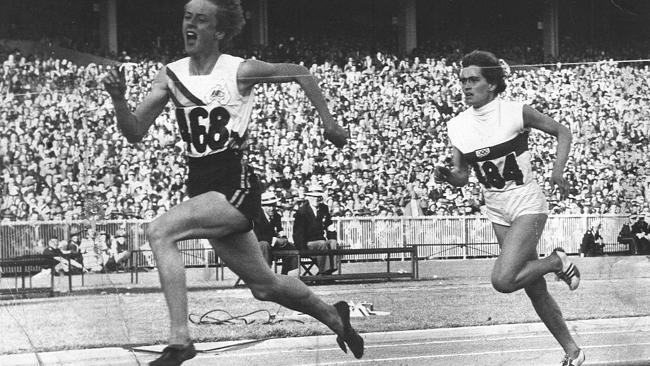
Betty Cuthbert wins the 220 metre sprint, Herald Sun Image Library
A shadow was cast over the games by the Suez crisis, resulting in Egypt, Lebanon and Iraq refusing to send athletes; and by Russia’s invasion of Hungary, resulting in Switzerland, Leichenstein, Netherlands and Spain absenting themselves. The water polo match between Russia and Hungary was called off because of injuries inflicted in the contest.
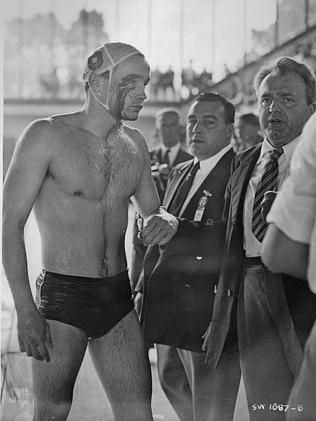
Injured Hungarian, Herald Sun Image Library

 1950's Melbourne